VePa: Revolutionizing Urban Parking with EV Charging Towers
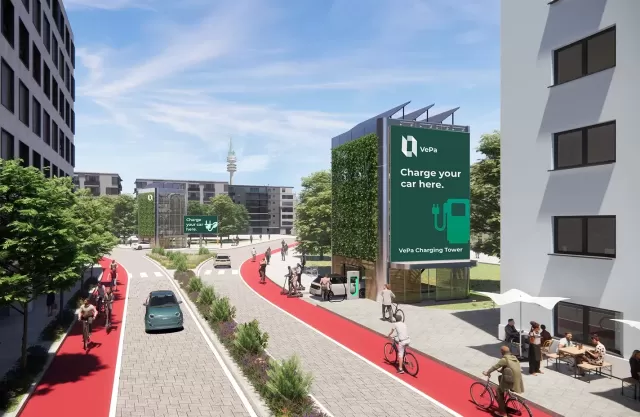
A groundbreaking startup is transforming urban landscapes by tackling the intertwined challenges of parking scarcity and electric vehicle (EV) charging accessibility. VePa, showcased at the IAA Munich auto show, offers a unique solution: a vertical parking system capable of accommodating 16 vehicles in a compact footprint of just over 525 square feet. This innovative design draws parallels to Carvana's automated car vending machines, but with the added benefit of integrated Level 2 EV chargers at each parking spot.
Currently, two VePa facilities are operational in the Munich area, with another under construction in Berlin and seven more in the planning stages.
How VePa Works
The user experience is designed for simplicity and convenience. Upon arrival, drivers register via a digital interface, entering their license plate number and payment details. The garage door opens, granting access to an available parking platform. Drivers park their car, exit the vehicle, and connect their personal Level 2 charging cable (a common practice in Europe). Once the vehicle is plugged in and the user has left the structure, an automated system lifts the car and seamlessly aligns the platform with an empty space.
Retrieving the vehicle is equally straightforward. Upon return, users simply enter their license plate number, and the system rotates their car back to ground level, allowing them to drive straight out through an exit door opposite the entrance.
Vehicle Size and Weight Restrictions
The Munich VePa installations have specific size and weight limitations. Vehicles must be no longer than 16 feet, 5 inches, no wider than 7 feet, 8 inches, and weigh no more than 5,950 pounds. This excludes some of the largest European SUVs. However, the Berlin facility has been adapted to accommodate slightly larger vehicles, up to 17 feet, 7 inches long and weighing up to 6,170 pounds. This expanded capacity can accommodate larger models like the Audi Q7 and BMW X7, although the weight of their electric variants remains a consideration.
VePa's Target Audience and Usage
VePa facilities are open to the general public and also offer private, leased options. A real estate developer has invested significantly in VePa, recognizing its potential as a cost-effective and space-saving alternative to traditional underground parking for apartment complexes.
The typical user includes individuals visiting the city center for short periods, such as for lunch or meetings, who need both parking and charging options. Apartment residents may also utilize the service for overnight charging. Furthermore, the facility we visited services subscription-based car-sharing and rental companies, providing a secure and accessible location for storing and retrieving vehicles. Current usage patterns indicate that approximately 60% of users utilize the system for parking, while 40% use it for EV charging.
Pricing and Potential Overstay Penalties
Parking is priced at €1 per 15 minutes ($4.69/hour) between 7 a.m. and 6 p.m., with an overnight fee of €10 ($11.72) kicking in thereafter. While there's no explicitly stated penalty for remaining connected after the charging is complete, the cost of electricity consumption during charging is generally less than the parking rate, effectively increasing the price once charging ceases.
VePa faces competition from other automated parking tower companies, many of which also provide EV charging. However, VePa distinguishes itself through its rapid assembly time (6 months), ease of disassembly, lower per-space construction costs, and impressive environmental impact. Each tower is estimated to save over 2,100 tons of CO2 per year.